Two houses on the same street, on lots that are functionally identical in size and water access, can carry price tags four million dollars apart. One is being sold for what it can become. The other is being sold for what it already is.
That gap is not a pricing mistake. On Bird Key, it is the entire market.
One Island, Two Products
Arvida platted Bird Key in 1959, dredging and filling roughly 250 acres just off the John Ringling Causeway into a fixed grid of single-family lots. That lot count has barely moved in more than sixty years. There are no condominiums here, no high-rises, no commercial parcels, just a guarded, entirely residential island of a little more than 500 homes, with roughly 300 of them touching deep-water canals or open bay.
What has changed is what sits on those lots. Walk the island today and the active inventory splits into two categories that behave nothing alike.
The first is a 1960s-era ranch, usually one story, often built before current flood elevation standards existed. The dock is original or close to it. The seawall has not been touched in decades. A buyer here is not really purchasing a house. They are purchasing the right to build one, and the existing structure is closer to a demolition line item than an asset.
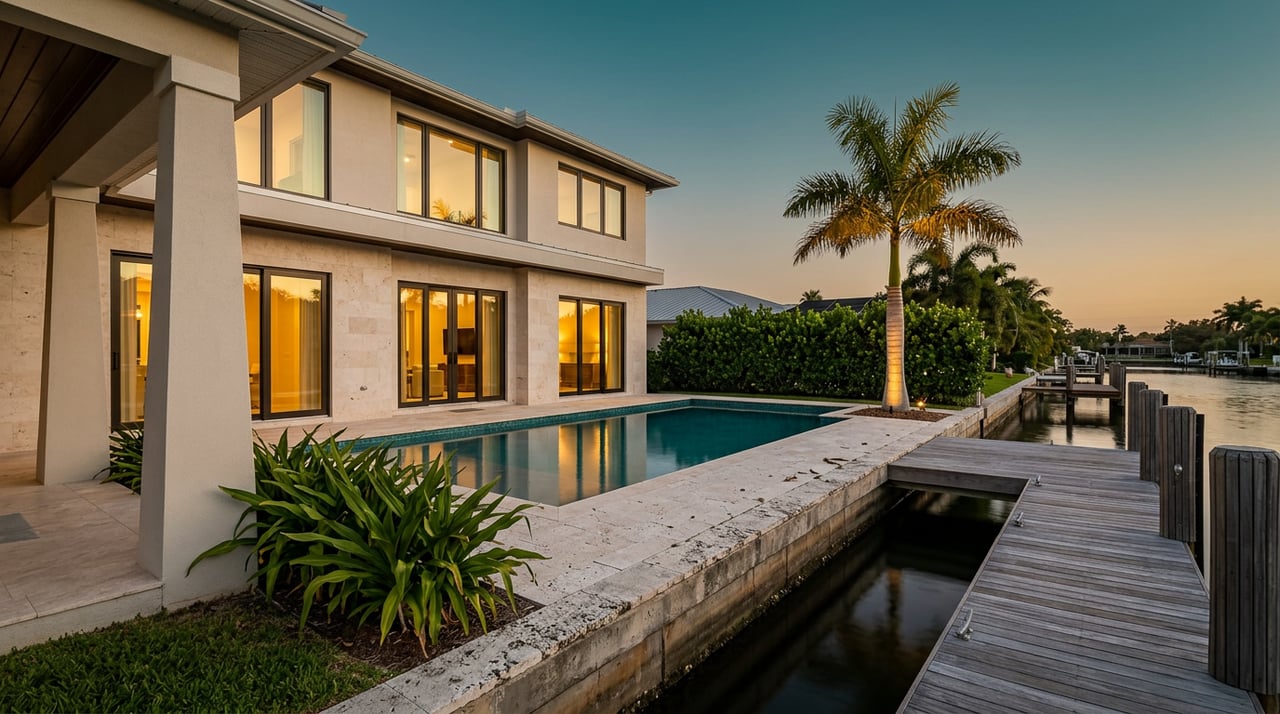
The second is a rebuilt or extensively renovated estate, typically two stories, elevated to current FEMA standards, with a refreshed dock and seawall and the floor-to-ceiling glass, resort-style pool, and outdoor kitchen that now define the island's newer product. A buyer here is paying for a finished, insurable house that requires no permitting fight and no months of temporary housing during construction.
| Lot-value trade | Finished-product trade | |
|---|---|---|
| Typical vintage | 1960s-era, one story | Rebuilt or heavily renovated, two story |
| Elevation status | Often non-elevated | Elevated to current FEMA standards |
| Dock and seawall | Original or dated | Rebuilt or recently refreshed |
| What the price reflects | The lot itself | Livable space, code compliance, insurability |
| Work remaining before move-in | Teardown or major rebuild | None |
Treat these as two points on one price curve and the math breaks immediately. A buyer who compares a rebuilt estate against a nearby ranch and calls the estate overpriced is comparing a car with a parts bin. A buyer who overpays for the ranch because "the comps down the street were higher" is paying finished-house money for a teardown.
Why the Published Median Doesn't Settle Anything
This is also why you will find genuinely different numbers depending on which market snapshot you happen to read. One widely circulated spring 2026 read put Bird Key's median list price near $3.87 million, at roughly $1,268 per square foot. A separate spring 2026 read, drawing on the same underlying portal data, put the median closer to $4.7 million with only about 31 homes on the market.
Both numbers can be accurate and still describe different months, because a market this thin gets reshuffled by every single listing that comes or goes. When only a handful of homes are actively for sale at any given time, one rebuilt bayfront estate hitting the market can pull the median up by hundreds of thousands of dollars, and one distressed ranch can pull it right back down. The published median on Bird Key is not measuring a stable center of value. It is measuring whichever mix of buckets happened to be listed the week the snapshot was taken.
The days-on-market and sale-to-list figures tell a more useful story, and they show some movement over the past year. A late 2025 read put typical Bird Key marketing time near 56 days. A spring 2026 read put it closer to 68 days, with homes closing around 93 percent of original list price. Those spring 2026 numbers sit inside the range of the broader Sarasota luxury tier, where sellers were receiving a median of roughly 93.7 percent of list that same season and bayfront properties above $3 million were often taking 120 to 180 days to find a buyer. Bird Key moves a bit faster than that broader luxury pool, largely because the island's supply is even tighter. In a typical month, only a handful of homes are actively listed at all. When the right one lists, a buyer who already knows which bucket they want can move in days. A buyer still anchored to the island median is often waiting six months for the next comparable to appear.
The Water Under the Dock Matters As Much As the Square Footage
Waterfront on Bird Key is not one thing either. Bayfront lots on the island's eastern edge sit on open, unrestricted deep water and can handle large sailboats and yachts without any bridge in the way. Canal-front lots split further into sailboat canals, which carry water depth sufficient for vessels over roughly 50 feet with no bridge restriction, and garden canals, which run at standard depth behind fixed bridges that cap both vessel size and air draft. Two canal-front listings can sit at the same price with very different real capacity for a boat, and that distinction rarely shows up clearly in a listing description.
For a buyer whose primary reason for choosing Bird Key is the boat, not just the water view, a few diligence items belong in the offer analysis alongside the kitchen finishes:
- Seawall age and condition, since replacement is a significant cost that does nothing for curb appeal
- Dock configuration and lift capacity relative to the vessel you actually own
- Whether the canal is a sailboat canal or a garden canal, and what that means for bridge clearance
- FEMA elevation status if the structure predates current code
- Insurance quotes obtained early, since combined wind, flood, and homeowners premiums on this stretch of Sarasota waterfront can run anywhere from roughly $18,000 to $45,000 a year depending on flood zone and construction vintage
That insurance spread alone is wide enough to change the real annual cost of two otherwise similar homes by tens of thousands of dollars. It belongs in the same conversation as the purchase price, not as an afterthought once the inspection period is nearly over. Buyers who want to confirm flood zone and elevation status before writing an offer can check the property address directly through FEMA's Flood Map Service Center.
A Yacht Club Rebuilding at the Same Time as the Housing Stock
The island's social center is going through its own version of the same transition. The Bird Key Yacht Club, the private club that anchors much of the island's social life around boating, dining, and tennis, is in the middle of a rebuild slated for completion at the end of 2026. The finished club is being positioned as one of the more modern yacht clubs in Florida, arriving at roughly the same moment the surrounding housing stock is completing its own shift from original 1960s construction toward elevated, code-current estates.
It is too early to say precisely how a rebuilt club moves individual home values. What is worth watching is the coincidence of timing. A club amenity and a housing stock modernizing on parallel tracks tends to raise the baseline expectation for what living on the island actually includes, which is exactly the kind of shift that widens the gap between the two buckets rather than closing it.
What This Means If You're Comparing Two Listings
The number worth tracking on Bird Key is not the headline median. It is the spread between the two buckets currently active on the island, and where a specific listing actually falls inside that spread. A ranch priced close to recent rebuilt-estate comps is asking you to pay finished-house money for a teardown. A rebuilt estate priced close to recent ranch comps is likely underpriced relative to what it would cost to reproduce today. Reading the market by bucket, not by median, is what keeps a buyer from misjudging either direction.
Is Bird Key currently a buyer's market or a seller's market? Supply is tight enough that well-positioned homes in either bucket still sell efficiently, but the wide day-on-market range shows that pricing mistakes get punished quickly. Sellers with strong positioning retain real leverage. Sellers who price a ranch like a finished estate, or vice versa, tend to sit.
Can any waterfront lot on Bird Key handle a large boat? No. Bayfront and sailboat-canal locations offer unrestricted deep water for larger vessels, while garden canals sit behind fixed bridges that cap both size and air draft. Confirm canal type before assuming dock capacity.
How much should I budget for insurance on a Bird Key home? Combined wind, flood, and homeowners premiums have run roughly $18,000 to $45,000 annually depending on flood zone and construction vintage as of recent 2026 quotes. Get quotes early in the process rather than waiting until under contract.
Bird Key rewards buyers and sellers who understand exactly which product is on the table, and punishes the ones who read the island by its headline number instead. If you are weighing a purchase, preparing to list, or trying to place a specific Bird Key property against the right comparable set, Roger Pettingell can walk through the specifics with you, bucket by bucket, dock by dock.
This article is general information, not legal, tax or financial advice. Consult a qualified professional about your situation.